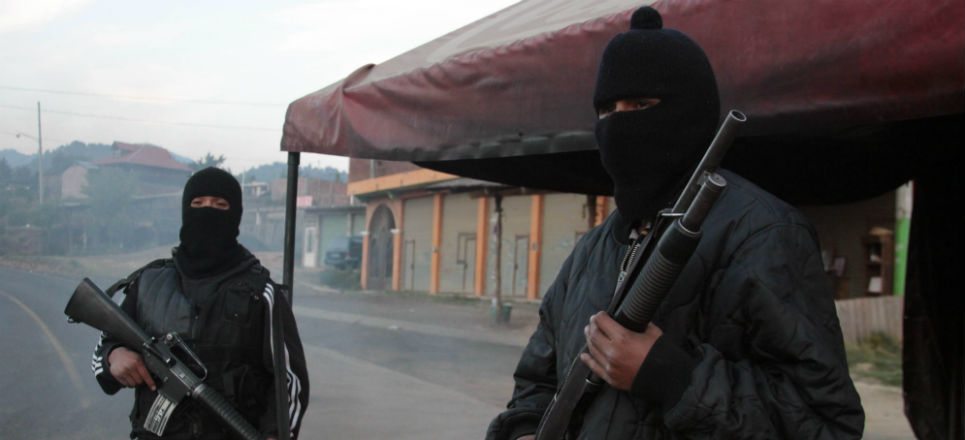
In the autumn of 2013, groups of civilians throughout rural Mexico – many of them members of Indigenous communities – made the international news headlines when they rose up against the country’s drug cartels, declaring that they would confront anyone, including generals and politicians, who threatened their families, lands and livelihoods. Journalists, politicians, generals and cartel bosses alike all saw these militias as new players on the Mexican political scene – and as posing a sudden and unprecedented challenge to the ‘rule of law’ in some areas, and to cartel dominance in others. The truth, however, is that similar groups have been shaping Mexican history, politics and even culture since at least the mid- nineteenth century.
I’m currently writing a book about the vitally important but consistently neglected history of militias in Mexico. Based on years of research in Mexican archives, as well as fieldwork in communities across the country, it explores how and why militias have formed in Mexican communities, particularly indigenous ones, since the country won its independence from Spain in 1821 – a victory that militias played a key role in winning for the Mexican insurgents!
Over the course of six chapters, it analyses in detail the ways in which the Mexican state, and non-state actors and institutions including the Church, revolutionary factions, bandits, and drug trafficking organisations, have all in turn responded to the emergence and activities of militia groups. And it argues that the interactions between all of these actors – militias, non-state actors and the state itself – have been essential to shaping the Mexican nation-state as we know it today, as well as the diverse ethno-cultural and socio-political identities of its inhabitants.
For example, the indigenous Cora (Náayari) people of the Gran Nayar region, for example, have a long history of fighting as part of such militias: I’ve already written in Small Wars & Insurgencies about how this helped their communities to keep hold of traditional landholdings in the face of political and economic reform (available here). Popular paramilitary forces based in other Indian communities meanwhile helped the nascent Liberal state defeat French invaders in the 1860s, and their direct descendants – the so-called ‘Defensas Sociales’ – again became a powerful force during the Revolution (1910-40), both resisting rebellions and advancing radical agrarian reform (all of which you can read about in my first book, Soldiers, Saints and Shamans).

But just as Mexico’s Indians are popularly seen as ‘standing on the margins of progress, on the margins of nationality and outside of history’, so too the role of the country’s predominantly indigenous militias in regional politics, and in the formation of the Mexican nation-state itself, has been largely ignored by academics, journalists and policy-makers alike, who present their modern successors as detached from their historical and cultural moorings, and who thus risk seriously misunderstanding them. My current book project will redress this situation by demonstrating the strong ties of history, memory, space and culture that link Mexico’s modern indigenous militias to their mid-nineteenth and early-twentieth century forebears.
 NATHANIEL MORRIS